



In today’s corporate meeting spaces, the LED display has become more than a presentation screen. It is now a central platform for collaboration, video conferencing, data sharing, and executive decision-making. As companies upgrade their meeting rooms, one important question often comes up: should you choose a 16:9, 21:9 or 32:9 LED screen for conference room use?
The right answer depends on your meeting format, content type, room size, and collaboration needs. While 16:9 remains the mainstream standard for presentations and video content, 21:9 is becoming increasingly relevant for online meetings, cross-border collaboration, and hybrid work scenarios where multiple types of content need to be shown at the same time.
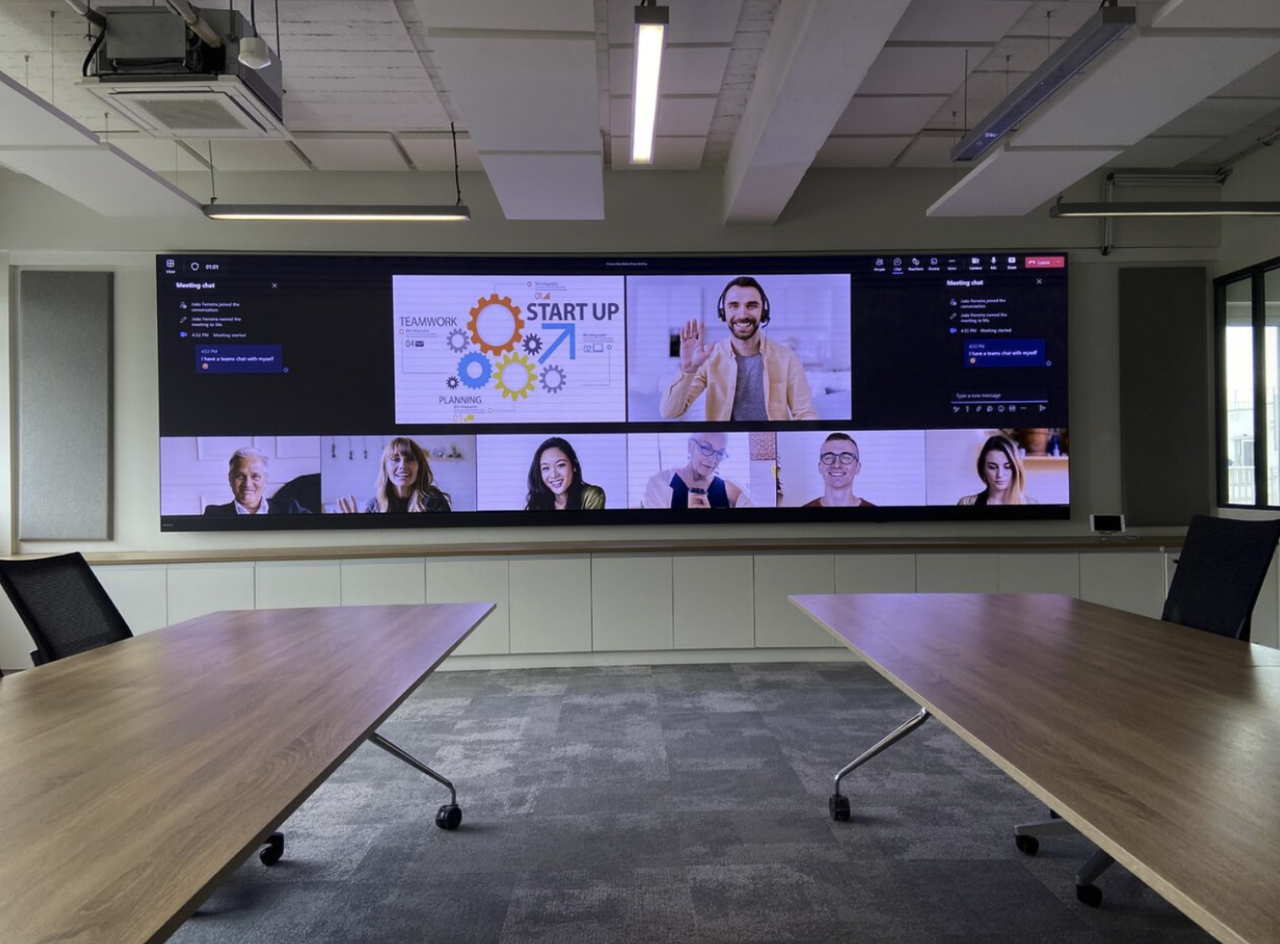
France – Schneider Electric: Headquarters in Rueil-Malmaison
Product: installation of a QSTECH X Wall Plus ( X Wall V2 ) 249” ultra-wide 32:9 display
Understanding 16:9: The Mainstream Standard
The 16:9 aspect ratio is the most widely used display format in business, education, broadcasting, and consumer electronics. It is the native format for most HD, 4K, and 8K content, as well as common presentation tools, video platforms, laptops, and conferencing systems.
For most businesses, a 16:9 LED screen for conference room applications offers excellent compatibility and ease of use. Standard PowerPoint presentations, videos, training materials, and video conferencing layouts can be displayed naturally without additional adjustment. This helps avoid letterboxing, pillarboxing, or stretched images, allowing the screen area to be used efficiently.
A 16:9 LED display also fits well into most conference room layouts. Whether used in executive boardrooms, training rooms, lecture halls, or standard corporate meeting spaces, it provides a familiar viewing experience and supports smooth daily operation with minimal setup complexity.
The Rise of 21:9 / 32:9: Better for Hybrid and Online Meetings
The 21:9 aspect ratio, often called ultrawide, provides more horizontal space than a standard 16:9 display. This makes it especially useful in meeting scenarios where users need to view multiple content sources at once.
In online meetings, multinational conferences, and hybrid collaboration environments, a 21:9 LED screen can support a more efficient layout. For example, one side of the screen can display the video conference window, while the other side shows a PPT presentation, shared document, dashboard, or meeting notes. This allows participants to follow both the speaker and the content without constantly switching windows.
This advantage is particularly valuable for global teams, remote collaboration, online training, and executive meetings where video communication and content sharing happen simultaneously. However, 21:9 may require more careful planning in terms of software compatibility, content layout, and wall space. For rooms that mainly use standard presentation materials, 16:9 is still often the simpler and more practical option.
QSTECH X-Wall V3: Built for Professional Conference Rooms
When choosing an LED screen for a conference room, aspect ratio is only one part of the decision. Display quality, system stability, interaction, audio performance, and installation flexibility are equally important.
The QSTECH X-Wall V3 All-in-One LED display is designed for professional meeting environments, with strong performance across hardware, software, system integration, and real-world business scenarios. Its key features include:
● Integrated Design: A slim 31mm cabinet integrates display, audio, processing, and control into one streamlined system.
● Visual Precision: Available in sizes such as 135" and 162", with full flip-chip COB packaging for enhanced durability, high contrast, and stable image performance.
● Flexible Interaction: The LiDAR accessory enables fast hand-based interaction with the display. A single LiDAR accessory can be conveniently deployed on QSTECH All-in-One LED displays of different sizes. After calibration, it is ready for use, while traditional infrared touch frames usually need to be customized according to screen size.
● Powerful Processing: Equipped with an 8-core CPU, 4-core GPU, and 6TOPS NPU, the system supports smooth decoding, multi-source display, and intelligent meeting applications.
● Immersive Audio: A built-in 6-chamber, 6-driver speaker system delivers clear and powerful sound for professional conference room environments.
With strong system integration and flexible interaction, QSTECH provides reliable LED display solutions for both standard presentation rooms and advanced collaborative meeting spaces.
Room Layout and Viewing Experience
The physical size of the meeting room also plays an important role in choosing between 16:9 and 21:9.
A 21:9 screen requires a wider installation wall, which may not be suitable for every meeting room. It is more suitable for spaces designed around hybrid meetings, video conferencing, and multi-window content display. In rooms with limited ceiling height but enough wall width, 21:9 can also provide a wider visual area without increasing vertical screen height.
By contrast, a 16:9 LED screen is easier to adapt to most standard conference rooms. It offers a balanced height-to-width ratio and supports a comfortable viewing experience for participants seated across the room. For many corporate boardrooms and training spaces, 16:9 remains the more universal and efficient choice.
Decision Matrix: Which Aspect Ratio Is Right for You?
When choosing the best LED screen for conference room use, consider the following factors:
| Factor | 16:9 LED Screen | 21:9 or 32:9 LED Screen |
|---|---|---|
| Best for | Standard presentations, videos, training rooms | Online meetings, cross-border meetings, hybrid collaboration |
| Content layout | Single main content source | Video call + PPT/document/dashboard side by side |
| Compatibility | Very high | Requires more layout planning |
| Room requirement | Fits most meeting rooms | Needs wider wall space |
| Ease of use | Plug-and-play | May require software/display adjustment |
● Primary Content: If your meetings mainly use slides, videos, training materials, and standard conferencing layouts, 16:9 is usually the best choice. If your meetings often combine video calls with PPT sharing, dashboards, or documents, 21:9 can provide better multitasking space.
● Meeting Type: For daily internal meetings and standard presentations, 16:9 offers simple operation and broad compatibility. For online meetings, cross-border communication, and hybrid collaboration, 21:9 can improve content organization and meeting efficiency.
● Room Conditions: 16:9 fits most meeting rooms and wall layouts. 21:9 or 32:9 requires more horizontal space and may need more planning for content layout and system configuration.
● Ease of Use: 16:9 is generally plug-and-play with most laptops and media sources. 21:9 or 32:9 may require users to optimize resolution settings or meeting software layouts for the best experience.
About QSTECH
As a pioneer in the LED display industry and a key subsidiary of CVTE, QSTECH has long focused on the research, development, and application of high-definition display solutions. Backed by strong R&D capabilities and an extensive patent portfolio from its parent company, QSTECH delivers professional All-in-One LED displays for conference rooms, education, commercial spaces, and enterprise collaboration.
The QSTECH X-Wall series combines high-quality display performance, integrated audio, intelligent processing, and flexible interaction to support modern meeting environments.
Ready to upgrade your workspace? Contact QSTECH to find the right LED display solution for your conference room.
FAQ:
1. Is 16:9 or 21:9 better for a conference room LED screen?
16:9 is better for most standard conference rooms, while 21:9 is better for hybrid meetings that combine video conferencing and content sharing.
2. When should I choose a 21:9 or 32:9 LED screen for a meeting room?
Choose 21:9 or 32:9 when your team often holds online meetings, multinational conferences, or hybrid meetings where video calls and PPT content need to be displayed at the same time.
3. Why is 16:9 still the mainstream choice?
Because most laptops, videos, PPT files, conferencing systems, and 4K/8K content are designed around 16:9.
4. Does 21:9 or 32:9 require special setup?
In many cases, yes. 21:9 or 32:9 may require optimized software layouts, display settings, and wider installation space.
5. What is the advantage of QSTECH’s LiDAR interaction?
QSTECH’s LiDAR accessory supports fast hand-based interaction and can be deployed across different sizes of QSTECH All-in-One LED displays after calibration, while infrared touch frames usually require size-based customization.


