



For procurement managers, IT directors, and system integrators, understanding the difference between COB LED and SMD LED is not just a technical exercise—it directly impacts visual quality, durability, maintenance costs, and long-term reliability.
This guide provides a clear, side-by-side comparison of COB technology versus traditional SMD, followed by practical tips to help you choose the right solution for your specific application.
COB vs SMD LED Displays
COB LED displays are usually the better choice for close-viewing, fine-pitch, high-end indoor applications where image smoothness, durability, contrast, and long-term stability matter most. SMD LED displays remain the practical choice for larger pixel pitches, outdoor displays, rental use, and budget-sensitive projects where fast on-site repair and lower initial cost are more important.
For most corporate boardrooms, control rooms, broadcast studios, and premium retail spaces, COB is becoming the preferred technology. For large-format advertising screens, stadiums, shopping mall atriums, and projects viewed from longer distances, SMD still offers excellent value.
Key Takeaways
· COB is stronger for ultra-fine pixel pitch, close viewing, high contrast, anti-collision protection, and camera-facing environments.
· SMD is stronger for cost control, mature supply chains, convenient lamp-level repair, outdoor brightness, and rental flexibility.
· The right choice depends on viewing distance, pixel pitch, installation environment, budget structure, maintenance expectations, and whether the display will be filmed by cameras.
What Are SMD and COB LED Technologies?
Before delving into the head-to-head comparison of SMD vs COB, it helps to understand how each is constructed.
SMD (Surface-Mounted Device)
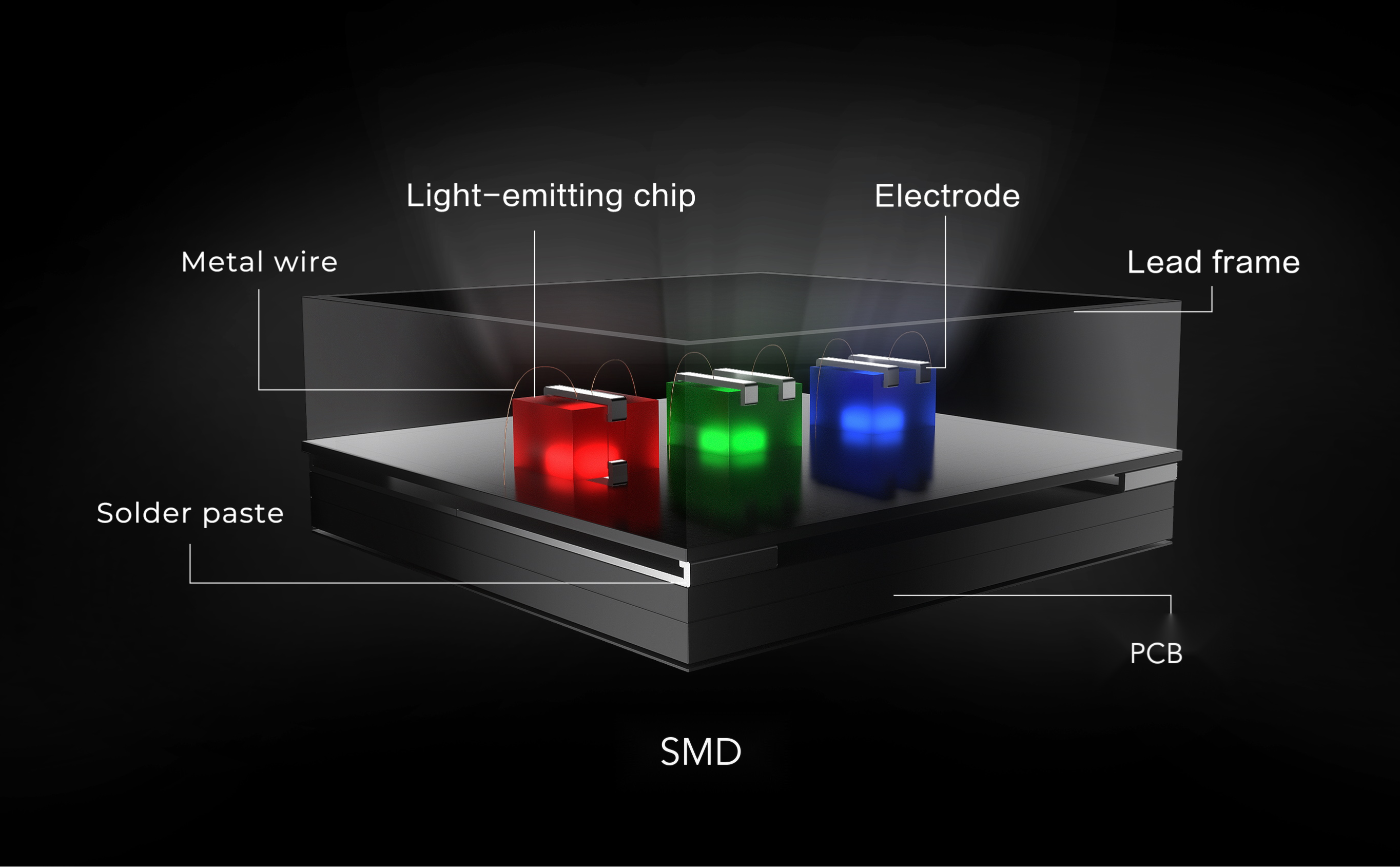
SMD is the mature, industry-standard approach. Red, green, and blue LED chips are first packaged inside a plastic housing to form a single “lamp bead.” These individual lamp beads are then soldered onto the surface of a PCB. This creates a point light source where each pixel is visibly distinct.
COB (Chip-on-Board)
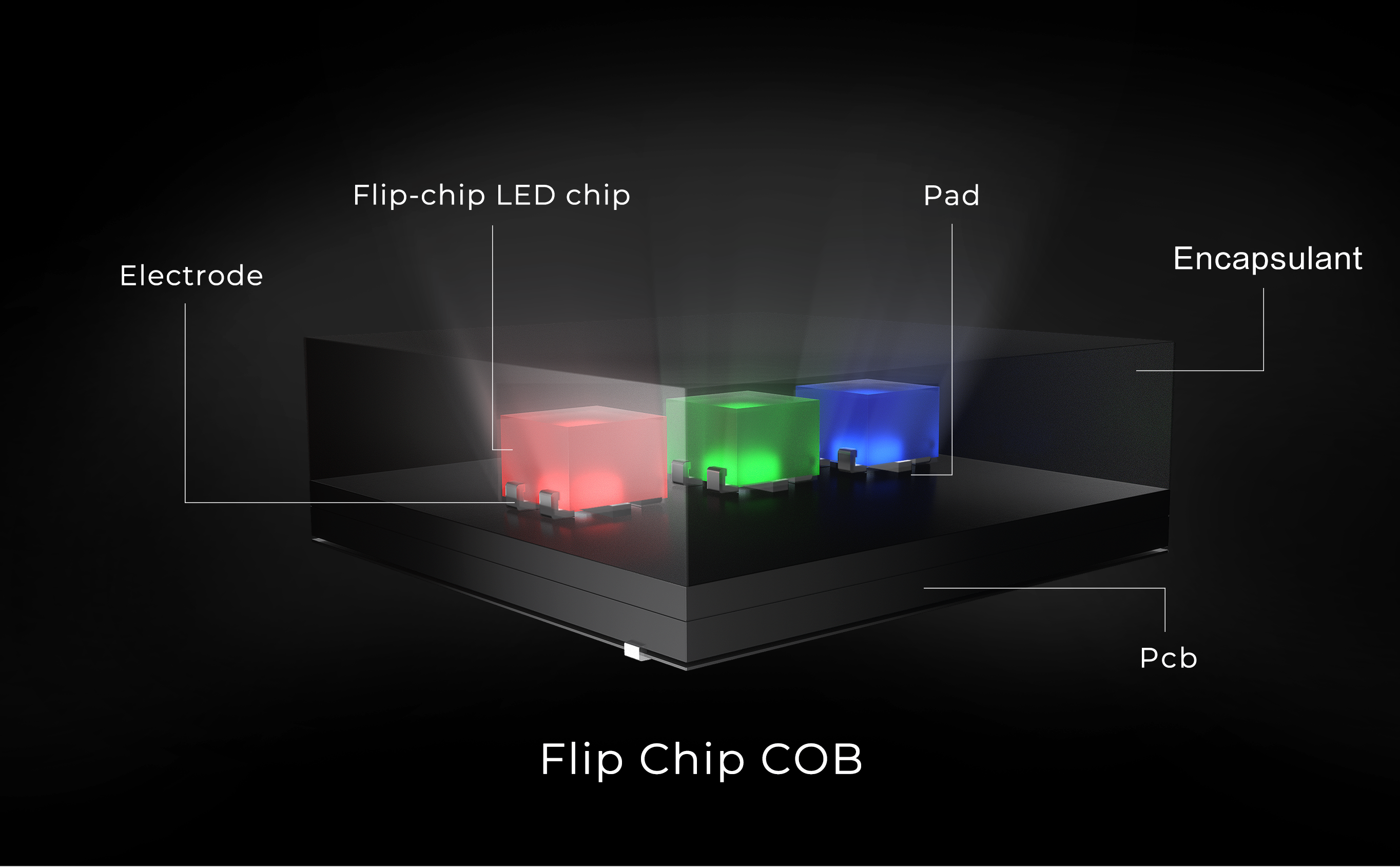
COB technology takes a fundamentally different approach. Instead of packaging chips individually, bare LED chips are mounted directly onto the PCB and then covered with a single protective resin layer. This creates a uniform surface light source with no visible gaps between pixels.
Why Packaging Technology Matters
Packaging technology affects more than the appearance of the LED screen. It influences how heat is transferred, how well the display resists impact and dust, how close viewers can sit without seeing pixel grain, and how stable the image remains during long operating hours.
In an SMD display, each LED package sits above the PCB as a separate component. This makes replacement more convenient, but it also leaves the lamp beads more exposed. In a COB display, the LED chips and surface are integrated into a sealed module. This improves protection and surface uniformity, but it also changes the maintenance model from lamp-level repair to module-level service.
For B2B projects, the packaging decision should be made early because it affects cabinet selection, pixel pitch, installation method, spare parts planning, and total cost of ownership.
Head-to-Head Comparison: COB LED vs SMD LED
The table below summarizes the essential differences between COB and SMD LED displays.
Comparison Dimension | SMD LED (Surface-Mounted Device) | COB LED (Chip-on-Board) |
Light Source | Point light (visible pixels) | Uniform surface light (no graininess) |
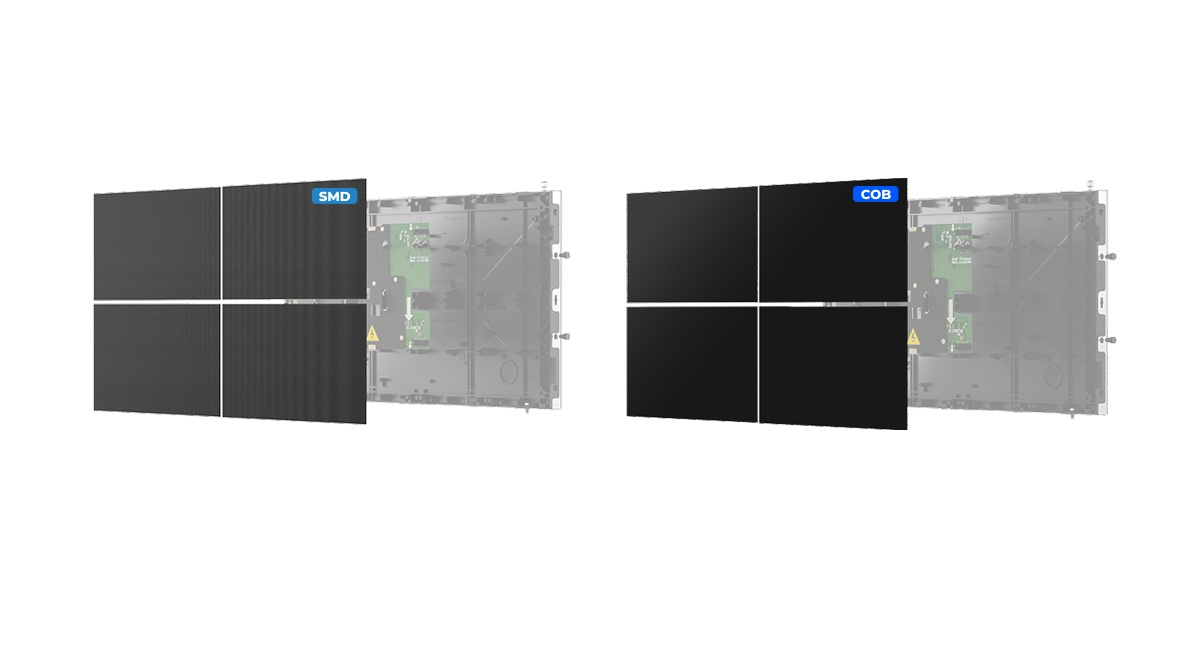
Visual Performance | Performs well in high-brightness applications, but may show visible pixels (graininess) at a close distance. | Delivers smoother, grain-free images, better contrast, and reduced glare. It provides a bigger viewing angle and is less likely to cause moiré patterns. |
Pixel Pitch Limits | Difficult to mass-produce for ultra-fine pitches (< P0.9) due to physical limitations. Ideal for conventional pitches (P1.25 and above). | Easily breaks the P1.0 limit. Can realize ultra-fine pixel pitches such as P0.9 and P0.5. |
Durability & Reliability | Exposed lamps are vulnerable to physical damage. Typical dead pixel rate is around 100 PPM. | Entirely covered and protected by epoxy resin, making it highly resistant to water, dust, fine sand, and wiping. Extremely low dead pixel rate (< 10 PPM). |
Heat Dissipation & Power | Heat dissipates through pins, resulting in a longer thermal path. | Chips transfer heat directly to the PCB, significantly improving heat dissipation and reducing power consumption. |
Repairability & Maintenance | Easy and convenient maintenance. Individual LED lamps can be repaired or replaced on-site. | Difficult to repair. Usually requires module-level replacement or factory repair due to its highly integrated and encapsulated structure. |
Initial Cost | Mature technology with a low cost and high cost-effectiveness. | Higher initial manufacturing costs due to complex packaging processes. |
Best Application Scenarios | Outdoor billboards, shopping mall screens, sports stadiums, and projects requiring high cost-effectiveness. | Fine-pitch displays, close-viewing environments, and high-end indoor displays (e.g., monitoring centers, broadcast screens). |
Additional Note:
Traditional SMD and early COB solutions use metal wires like gold wires for electrical connections. Full flip chip COB removes wire bonding completely by directly flipping and attaching the chip onto the PCB. This design reduces failure risks and enhances reliability and heat dissipation.
SMD vs COB LED Display Choosing Tips
Rather than declaring one technology universally superior, the practical question is: which is right for your specific project?
Choose SMD if:
· Your audience views the screen from 10 meters or more.
· The installation is outdoors or in a high-brightness environment.
· Your budget is cost-sensitive, and on-site maintainability is a priority.
· The display will be used for rental events or touring productions where easy disassembly and single-unit repair matter.
Choose COB if:
· Viewers will be seated or standing within 1–8 meters of the screen.
· The display will be camera-facing (like broadcast studios, live streaming setups, XR virtual production).
· The installation is in a high-traffic area prone to physical contact or harsh cleaning routines.
· You require mission-critical reliability with minimal downtime — such as in control rooms or 24/7 operations.
COB vs SMD Selection Matrix
Use the matrix below as a practical starting point when comparing COB and SMD LED display options for an indoor or outdoor project.
Project Requirement | Recommended Technology | Reason |
Viewing distance under 3 meters | COB | Smooth surface light, less visible pixel grain, and stronger close-range visual comfort. |
Viewing distance over 10 meters | SMD | Pixel grain is less noticeable from long distance, making SMD more cost-effective. |
Pixel pitch below P1.0 | COB | COB is better suited for ultra-fine pixel pitches because chips are mounted directly on the board. |
Outdoor advertising or stadium screen | SMD | SMD is mature for high-brightness outdoor applications and large-format projects. |
Broadcast studio or camera-facing wall | COB or high-end SMD | COB reduces graininess and glare; high-end SMD can work when optimized for refresh rate and moire control. |
High-traffic public area | COB | The resin-protected surface improves resistance to impact, dust, fingerprints, and cleaning. |
Lowest initial budget | SMD | SMD usually has lower upfront cost due to mature manufacturing and supply chains. |
Lowest downtime for critical operations | COB | COB offers stronger physical protection and lower dead pixel risk, reducing service interruptions. |
Fast on-site lamp repair | SMD | Individual lamp beads are easier to replace during field service. |
How Viewing Distance Affects the Choice
Viewing distance is one of the most reliable ways to narrow the decision. When viewers are close to the screen, pixel structure, glare, seams, and color uniformity become easier to notice. This is why COB is often selected for boardrooms, command centers, museums, and premium retail spaces where people stand close to the display.
When viewers are far away, the advantages of ultra-fine pitch and surface uniformity become less obvious. In those projects, SMD can deliver strong visual performance at a lower cost, especially for large screens in malls, transportation hubs, stadiums, and outdoor advertising environments.
How Maintenance Strategy Affects the Choice
SMD maintenance is typically more flexible at the component level because individual lamp beads can be repaired or replaced. COB maintenance is different: the sealed surface improves protection and reliability, but damaged modules are usually handled through module replacement or factory-level repair.
For projects where frequent physical contact, dust, or cleaning is expected, COB can reduce the probability of damage. For rental and touring projects where fast component replacement is part of the operating model, SMD may still be more convenient.
Application-Based Recommendations
Control Rooms and Command Centers
For command centers, smart city control rooms, traffic monitoring centers, and security operation centers, COB is usually the stronger choice. These environments require 24/7 operation, close viewing, low failure rates, comfortable brightness, and stable image quality across the entire screen.
Broadcast Studios and Virtual Production
For broadcast and camera-facing environments, the decision should consider refresh rate, grayscale performance, moire control, color accuracy, and viewing angle. COB performs well because the surface is smoother and less grainy, while high-end SMD solutions can also be effective when engineered specifically for filming.
Corporate Boardrooms and Executive Spaces
For boardrooms, meeting rooms, and executive briefing centers, COB is often preferred because viewers sit close to the screen and expect clean text, smooth charts, low glare, and premium visual quality. If the budget is tighter and the viewing distance is longer, fine-pitch SMD can still be a practical option.
Retail, Museums, and Public Spaces
In premium retail and exhibition spaces, the LED display may be touched, cleaned frequently, or viewed from very short distances. COB offers better surface protection and a more refined image. SMD remains suitable for larger signage zones where the screen is installed out of reach and viewed from farther away.
QSTECH offers purpose-built products for both SMD and COB applications. Below are some of our flagship offerings.
QSTECH Offers Leading SMD and COB LED Display Solutions
QSTECH H27 Pro Series
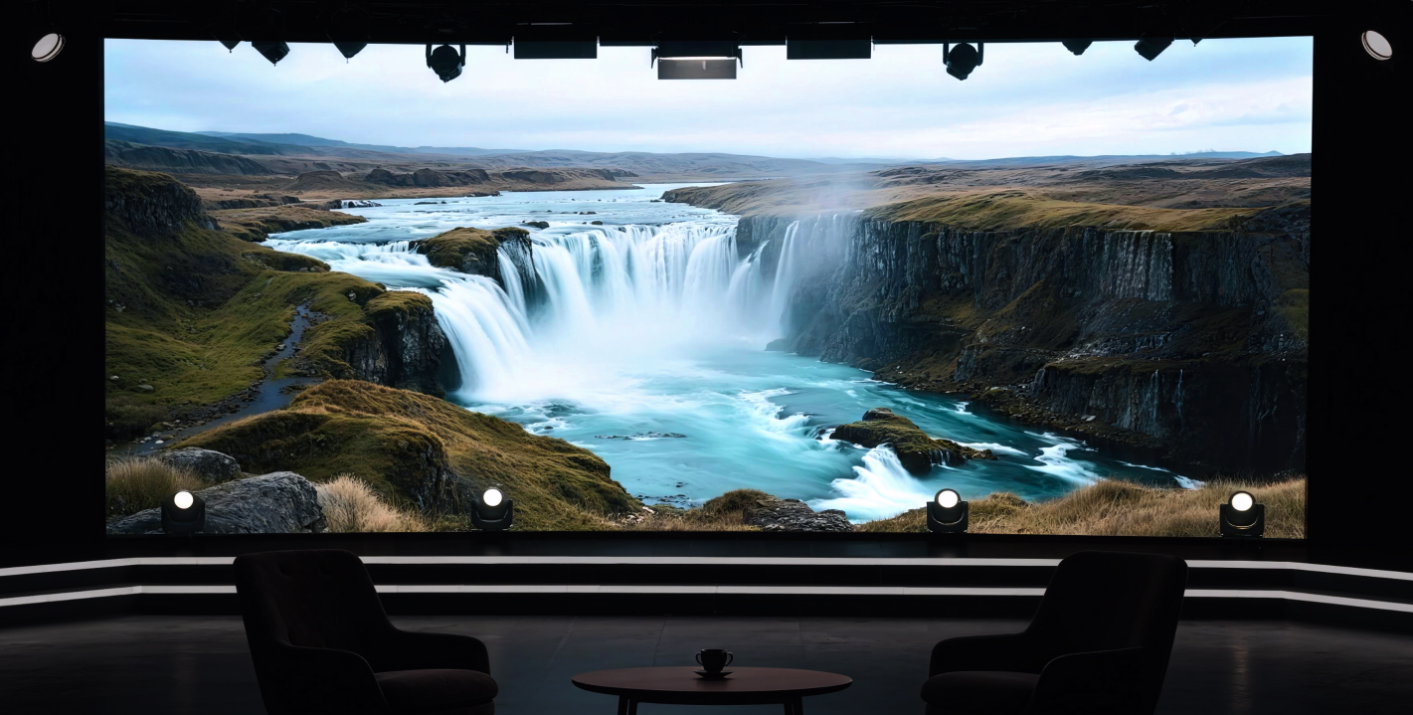
The H27 Pro Series is a high-end indoor SMD LED display built for mission-critical environments where zero downtime and broadcast-quality visuals are non-negotiable.
Key Features
Feature | Description |
Packaging Technology | SMD (Surface-Mounted Device) |
Pixel Pitches | 1.2mm, 1.5mm, 1.9mm, 2.5mm |
Contrast Ratio | Up to 10,000:1 (base 6,500:1) |
Refresh Rate | Up to 7680 Hz (base 3840 Hz) |
Brightness | 550 nits standard (1.2mm offers 1000 nits option) |
Cabinet Size | 610 × 343 × 31 mm |
Cabinet Weight | 4.8 kg |
Why Choose H27 Pro?
· Dual Redundant Power & Signal – Built-in backup systems prevent blackouts, ensuring uninterrupted operation.
· Moiré-Free Shooting – Specialized optical surface eliminates moiré patterns, making it ideal for camera capture.
· 15% Energy Savings – Patented voltage control reduces power consumption at the chip level.
· Ambient Light Intelligence – Automatically adjusts brightness (0–800 nits) to match room lighting, reducing eye strain.
· Floating Adjustment Mechanism – Ensures perfect flatness out of the box, simplifying installation.
Best For
· Broadcast studios and virtual production
· Sports venues and live event displays
· Corporate lobbies and large meeting rooms
In short: H27 Pro delivers SMD reliability with broadcast-grade clarity, redundancy, and smart energy management.
QSTECH CX27 Series
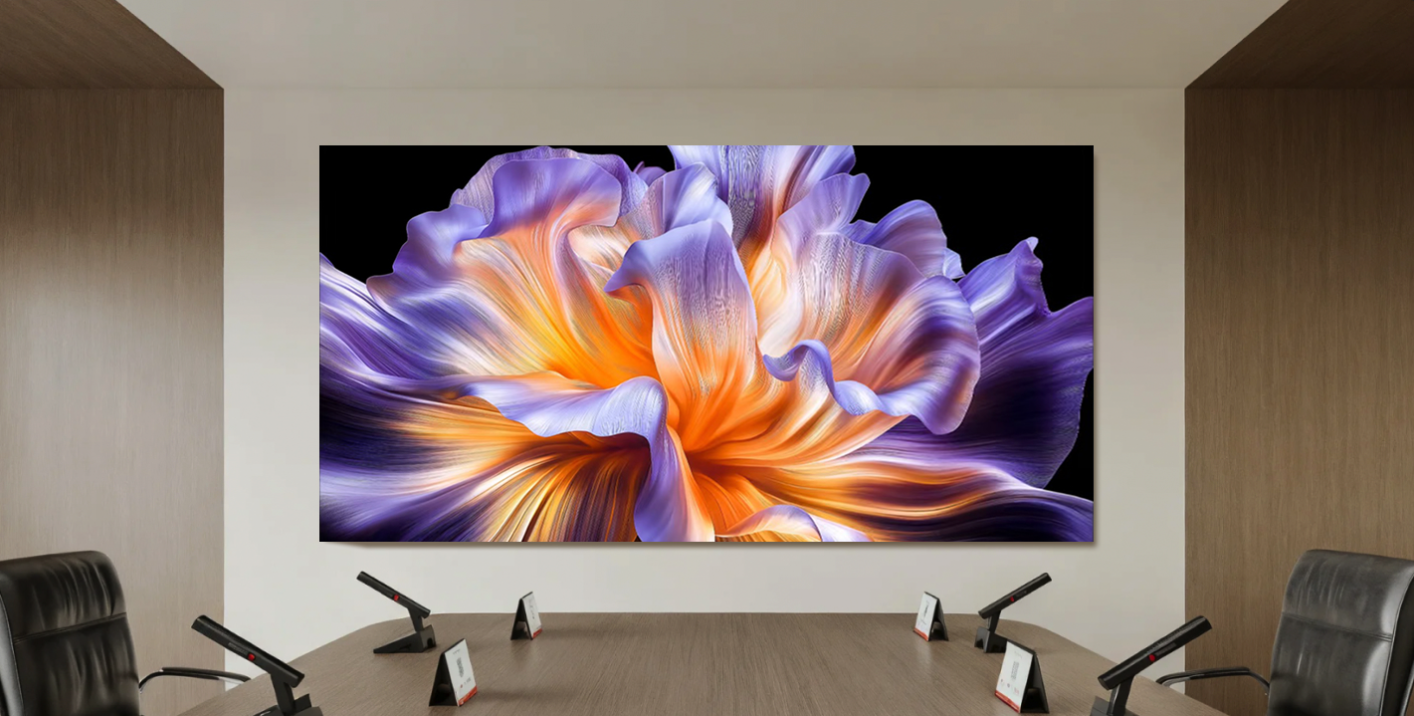
The CX27 Series is QSTECH’s flagship COB technology solution, designed for premium indoor environments that demand the highest image quality, durability, and energy efficiency.
Key Features
Feature | Description |
Packaging Technology | Flip-Chip COB (Chip-on-Board) |
Pixel Pitches | 0.7mm, 0.9mm, 1.2mm, 1.56mm |
Contrast Ratio | 15,000:1 |
Refresh Rate | 3840 Hz |
Brightness | Up to 800 nits (600 nits for 0.7mm) |
Cabinet Size | 600 × 337.5 × 31 mm |
Cabinet Weight | 3.8 kg |
Why Choose CX27?
· Hyper Bit 2.0 Technology – Delivers 64x richer grayscale details, capturing subtle shadows and highlights for a lifelike image.
· Uniform Surface Light Source – Eliminates pixel graininess, providing a smooth, immersive viewing experience even from inches away.
· Common Cathode Driving – Reduces energy waste by allocating precise voltage to each color chip, lowering power consumption.
· TÜV Rheinland Certified – Hardware-level blue light filtering protects viewers’ eyes during long hours of use.
· Magnetic Locking System – Enables effortless, one-hand cabinet connection and alignment.
Best For
· Smart city command and control centers
· Corporate boardrooms and executive meeting spaces
In short: CX27 is one of QSTECH’s most advanced COB displays, combining extreme contrast, broadcast-friendly visuals, and user health protection.
QSTECH FM27 Series
The FM27 Series is a versatile indoor LED display. It allows you to choose between COB and SMD technologies within the same standardized cabinet framework – giving you flexibility without changing your mounting infrastructure.
Common Platform Specifications (Both COB & SMD)
Feature | Description |
Cabinet Size | 600 × 337.5 × 31 mm (16:9 golden ratio) |
Cabinet Weight | ~3.4 kg |
Refresh Rate | 3840 Hz |
Maintenance | Full front service access |
Installation Options | Wall-mounted, hanging, floor-standing, corner, curved, column mounting |
Option A: FM27 COB Variants (FM2709C, FM2712C, FM2715C)
Feature | Specification |
Pixel Pitches | 0.9mm, 1.2mm, 1.5mm |
Contrast Ratio | 15,000:1 |
Brightness | Up to 800 nits |
Protection | Built-in optical film |
Best for: Close-up viewing, premium retail, executive suites, and applications requiring superior image smoothness.
Option B: FM27 SMD Variants (FM2715S, FM2718S, FM2725S)
Feature | Specification |
Pixel Pitches | 1.5mm, 1.8mm, 2.5mm |
Contrast Ratio | 6,500:1 |
Brightness | 550 – 600 nits |
Optional Protection | GOB (Glue-on-Board) or HOB protection |
Best for: Budget-conscious projects, general indoor signage, and applications where on-site repairability is valued.
Why Choose FM27?
· One infrastructure, two technologies – Upgrade from SMD to COB later without changing cabinets.
· Low power sleep mode – Reduces energy consumption during inactive periods.
· Fast assembly – Large module design with optional quick-lock mechanisms.
· Creative flexibility – Supports curved, corner, and column installations.
In short: FM27 is the ideal choice when you want to keep options open – start with SMD for affordability, or go straight to COB for premium quality, all on the same platform.
Frequently Asked Questions About COB and SMD LED Displays
Is COB better than SMD LED?
COB is better for close-viewing, fine-pitch, high-end indoor LED displays where image smoothness, durability, and long-term reliability are priorities. SMD is better when the project requires lower initial cost, easier lamp-level repair, high outdoor brightness, or large-format display coverage.
Is COB LED more expensive than SMD?
In most cases, COB has a higher initial cost because the packaging process is more complex. However, the total cost of ownership can be competitive when the project values lower dead pixel risk, stronger surface protection, reduced cleaning damage, and longer stable operation.
Which technology is better for fine-pitch LED displays?
COB is generally better for ultra-fine pixel pitches, especially below P1.0, because chip-on-board packaging supports a denser and more uniform pixel structure. This makes it suitable for premium indoor LED walls, control rooms, boardrooms, and studios.
Which technology is better for outdoor LED displays?
SMD remains widely used for outdoor LED displays because it is mature, cost-effective, bright, and easy to maintain. COB is more commonly used in premium indoor applications, although packaging technologies continue to evolve.
Can COB LED displays be repaired on site?
COB displays are usually serviced at the module level rather than by replacing individual lamp beads on site. This is different from SMD displays, where lamp-level maintenance is more common. The benefit of COB is that the sealed surface reduces many common causes of LED damage.
How do I choose between QSTECH COB and SMD products?
Start with viewing distance, pixel pitch, installation environment, camera requirements, and budget. QSTECH H27 Pro is suitable for high-end SMD indoor applications, CX27 is designed for premium COB environments, and FM27 provides a flexible platform that supports both COB and SMD variants.
Get a Project-Based Recommendation from QSTECH
If you are comparing COB vs SMD LED displays for a real project, QSTECH can help evaluate the best technology based on your viewing distance, target pixel pitch, installation environment, content type, maintenance requirements, and budget range.
To receive a more accurate recommendation, share your screen size, viewing distance, indoor or outdoor environment, expected operating hours, installation method, and whether the display will be used for camera shooting. QSTECH’s LED display specialists can then recommend the most suitable product series, pixel pitch, and configuration.
The COB LED vs SMD LED decision ultimately comes down to four key variables: viewing distance, environmental conditions, budget structure, and whether camera performance matters.
SMD remains a robust, proven, and cost-effective solution for most large-format and outdoor applications. COB technology, particularly in its flip-chip form, has matured rapidly and now represents the benchmark for indoor fine-pitch, close-range, and broadcast-grade display environments.


