



Key Takeaways
- Compare the two options against the room, content, ambient light, collaboration workflow, and lifecycle support plan.
- Interactive display value increases when annotation, sharing, and recurring room readiness are important.
- Use a project-specific comparison rather than assuming one technology is right for every room.
Selection and Planning Checklist
| Comparison | Interactive conference room display | Traditional projector |
|---|---|---|
| Collaboration | Can support touch and integrated sharing workflows | Usually relies on separate tools for interaction |
| Ambient light | Designed for direct-view display use | Image performance depends more on room-light control |
| Installation | Requires display mounting and system planning | Requires projector position, screen, and alignment planning |
| Best-fit scenario | Frequent hybrid collaboration and shared annotation | Temporary or budget-led presentation environments |
Modern meeting spaces demand more than basic presentation tools. Businesses expect technology that improves communication, accelerates decision-making, and supports hybrid collaboration. As organizations embrace digital transformation, choosing between an interactive conference room display and a traditional projector has become an important investment decision.
We have worked with organizations across multiple industries and have seen how display technology directly influences meeting efficiency. While projectors have served conference rooms for decades, today's interactive LED display solutions deliver significant improvements in image quality, collaboration, reliability, and long-term value.
This comparison explores the key differences between these two technologies and explains why more businesses are replacing projectors with modern interactive display systems.
Performance Comparison: Beyond Traditional Projection
Traditional projectors rely on reflected light, making image quality highly dependent on room brightness. Even premium models often require dimmed environments to maintain visibility, reducing participant engagement and limiting flexibility.
An interactive LED display generates its own light, producing consistently vibrant images regardless of ambient lighting. Employees can clearly view charts, spreadsheets, engineering drawings, and multimedia presentations without adjusting room conditions.
Resolution is another major differentiator. Projectors may lose sharpness as screen sizes increase or after prolonged use due to lamp aging. LED displays maintain exceptional clarity across the entire screen throughout their lifespan.
Color accuracy also plays a critical role in business presentations. Product demonstrations, architectural designs, medical imaging, and financial dashboards all require precise color reproduction. Modern interactive conference room display solutions provide richer colors, deeper contrast, and more accurate visual details.
Maintenance requirements further separate the two technologies. Projectors require periodic lamp replacements, filter cleaning, and optical calibration. These maintenance tasks increase operating costs and create unnecessary downtime.
By comparison, an interactive LED display offers a maintenance-friendly architecture with no projector lamps to replace. Businesses benefit from greater reliability, longer operating life, and lower total cost of ownership.
Collaboration Experience: Interactive Displays Transform Meetings
Business meetings have evolved from one-way presentations into highly collaborative discussions. Participants now expect to annotate documents, brainstorm ideas, and share content instantly.
Traditional projectors primarily function as display devices. Although interactive accessories exist, they often require additional hardware, calibration, and software integration that complicate the meeting experience.
An interactive conference room display combines presentation, collaboration, and communication into one integrated platform. Team members can write directly on the screen, annotate presentations, highlight important information, and collaborate naturally.
Wireless content sharing further enhances productivity. Employees can connect laptops, tablets, or mobile devices without complicated cables, allowing presenters to switch seamlessly during meetings.
Hybrid work environments benefit even more from interactive technology. Remote participants receive clearer visuals, synchronized annotations, and a more engaging meeting experience, helping bridge the gap between onsite and virtual attendees.
Because the interactive LED display becomes the focal point of collaboration rather than simply projecting an image, meetings become faster, more engaging, and more productive.
Product Spotlight: X Wall V3 – An Interactive LED Display for Modern Collaboration
Organizations looking for a professional interactive LED display need a solution that goes beyond passive viewing—one that actively engages participants, enables real-time collaboration, and adapts to diverse meeting dynamics. This is where the QSTECH X Wall V3 delivers. As an integrated interactive LED display, it transforms conference rooms, training spaces, exhibition areas, and corporate events into dynamic environments where ideas come to life.
Meetings Should Be Like This captures the vision behind the X Wall V3. At its core, this interactive LED display is built to facilitate participation. Powered by Android 13.0, the system features an intuitive touch interface that enables seamless collaborative annotation, video conferencing, and content sharing. Whether brainstorming in a creative session or presenting to a large audience, users can interact directly with the display, making meetings more engaging and inclusive.
For teams that rely on familiar PC-based workflows, the X Wall V3 also integrates Windows 10, ensuring smooth operation of office applications and professional conferencing platforms. With extended peripheral support, this interactive LED display connects effortlessly with external devices—cameras, microphones, laptops, and more—allowing every participant to contribute, whether in the room or joining remotely.
Interaction is at the heart of the X Wall V3, and its touch technology options are designed to keep the experience seamless in any environment. The Radar Touch solution works flawlessly from sunlit rooms to dark conference spaces, installing in minutes and adapting to various display sizes for consistently reliable touch control. Meanwhile, the Infrared Touch option delivers lag-free writing with pixel-perfect accuracy. Every stroke appears instantly, ensuring that ideas are captured exactly as intended—so the conversation flows without technical interruption.
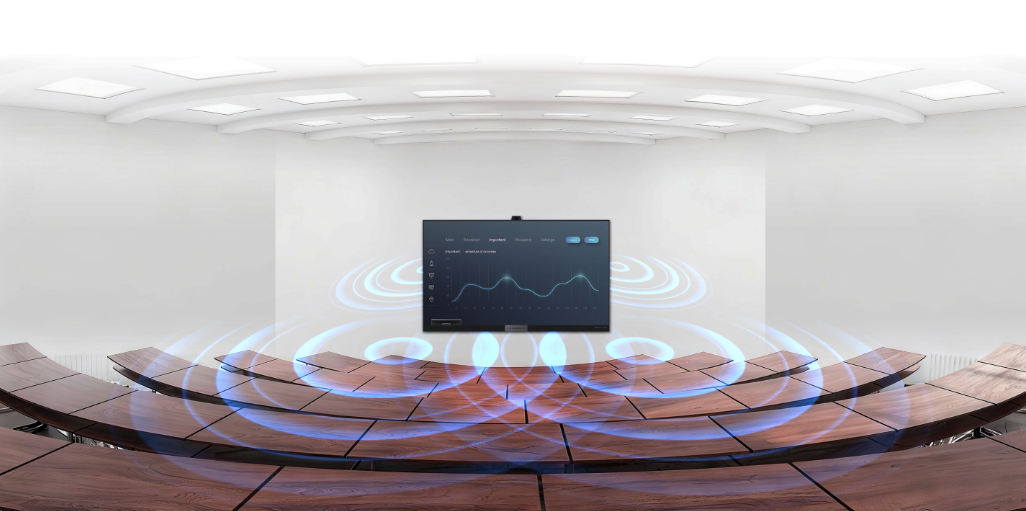
An interactive LED display is not just about visuals—it is about creating an immersive experience for every participant. The X Wall V3 features powerful audio with 95dB impactful sound pressure, delivering clear, full vocals and rich, layered music. In large conference rooms, speeches remain engaging and dynamic, ensuring that every attendee—whether actively interacting with the screen or listening from a distance—stays connected to the content and the conversation.
Beyond interaction and audio, the X Wall V3 is engineered for simplicity. Its integrated structure minimizes installation complexity, allowing businesses to deploy this interactive LED display quickly and adapt their spaces with ease. From huddle rooms to boardrooms and multi-purpose venues, the system provides a versatile hub for face-to-face and hybrid collaboration.
For organizations seeking an interactive LED display that truly engages users, the QSTECH X Wall V3 offers the ideal balance of responsive touch, powerful audio, and intuitive operation—everything needed to make every meeting a productive, interactive experience.
Making the Right Investment for Future AV Deployment
Choosing the right interactive LED display requires more than evaluating screen quality alone. Businesses must consider how the display facilitates participation, supports hybrid workflows, and adapts to evolving collaboration needs. Traditional passive displays may show content, but they do little to involve the audience or streamline teamwork.
An interactive LED display like the X Wall V3 transforms communication by turning every presentation into a two-way dialogue. Whether used in conference rooms, training sessions, or collaborative workshops, it empowers users to annotate, share, and interact in real time—making meetings more efficient and ideas more memorable.
At QSTECH, we specialize in developing interactive LED display solutions that address the real-world needs of modern businesses. Through advanced touch technologies, thoughtful user experience design, and robust manufacturing capabilities, we help organizations build smarter, more engaging visual communication environments.
Ready to make your meetings more interactive? Contact QSTECH today to discover how the X Wall V3 interactive LED display can enhance collaboration, streamline communication, and bring your teams closer together.
FAQ
Why are businesses replacing traditional projectors with interactive conference room displays?
An interactive conference room display delivers brighter visuals, higher resolution, and built-in collaboration features. Compared with projectors, it requires less maintenance, performs consistently in bright rooms, and supports more productive hybrid meetings.
What are the main advantages of an interactive LED display in conference rooms?
An interactive LED display provides vivid colors, excellent contrast, sharp image quality, and responsive touch interaction. It also enables wireless content sharing, real-time annotation, and long-term reliability, making it ideal for modern business collaboration.
Is an interactive conference room display a better long-term investment than a projector?
Yes. Although the initial investment may be higher, an interactive conference room display reduces maintenance costs, eliminates projector lamp replacements, offers a longer service life, and delivers a lower total cost of ownership over time.
Which industries benefit most from interactive LED display solutions?
Industries including corporate offices, education, healthcare, finance, engineering, and government benefit from interactive LED display solutions because they improve presentation quality, collaborative discussions, remote communication, and data visualization across diverse meeting environments.
Why should businesses choose QSTECH for interactive conference room displays?
QSTECH, a wholly-owned subsidiary of CVTE, a global high-tech enterprise focused on interactive display and AI, and a market leader in LCD main control boards and intelligent interactive flat panels. Our interactive LED display solutions deliver outstanding image quality, reliable performance, and efficient collaboration for modern conference rooms.
Official Product Reference
For current X Wall V3 specifications and available configurations, review the X Wall V3 product page. Product data are subject to change without prior notice.
About QSTECH
QSTECH is a wholly-owned subsidiary of CVTE and provides LED display solutions for professional applications. Product selection should be based on the project environment, content, viewing conditions, installation design, and applicable local requirements.
Project Note
Product specifications and availability are subject to the current official product page and final project configuration. Confirm structural design, electrical work, permits, safety requirements, and local regulations with qualified project professionals before installation.
Contact QSTECH to discuss a display configuration that fits your project requirements.


